The quality of refined gasoline dropping pre WWI

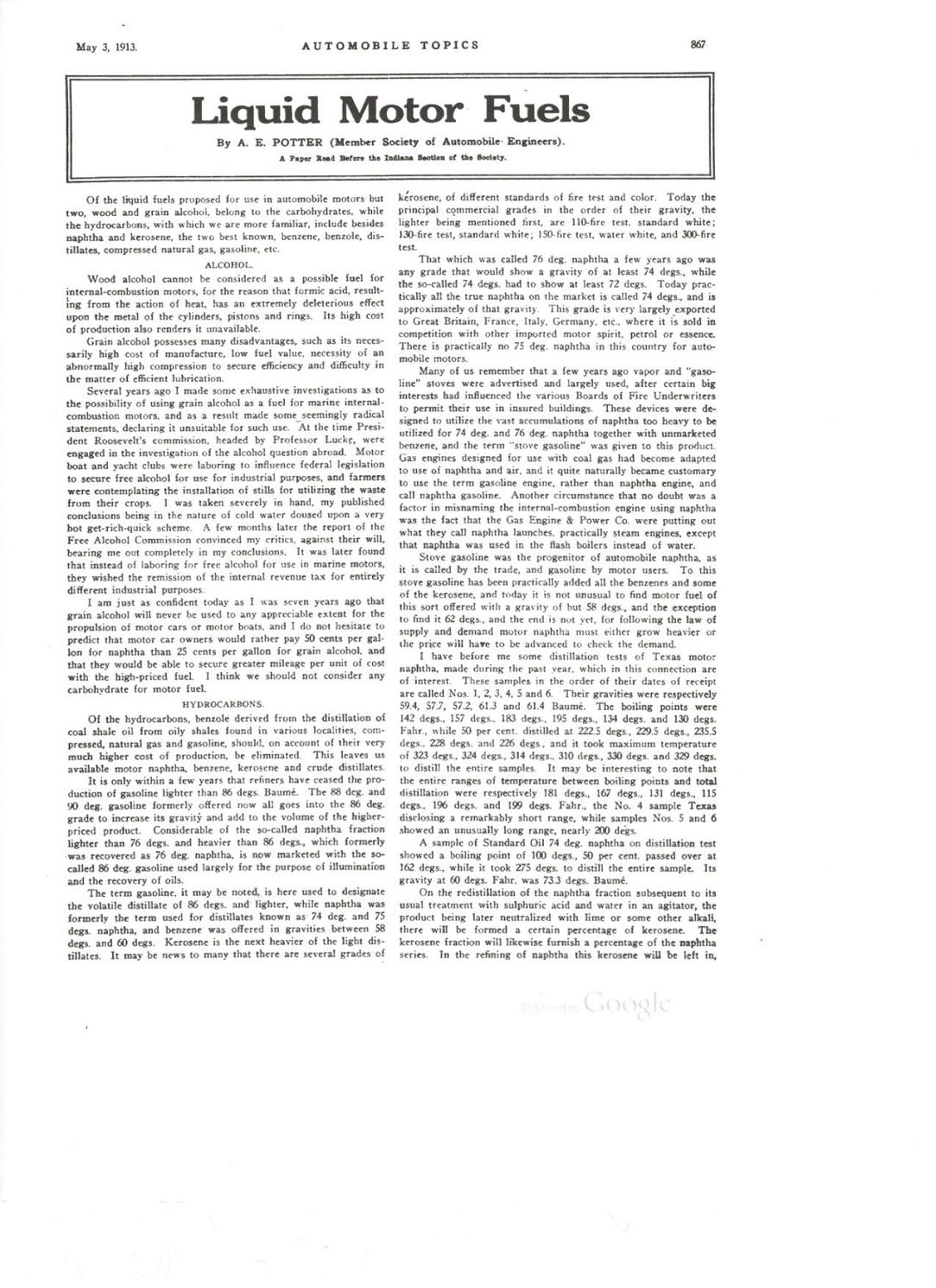
Those worried about the mixing of gasoline for fuel - from an early article on fuel.

So if you remember your history (History is bunk), early processing of petroleum was to refine and produce kerosene. A by product of kerosene production was was gasoline. Produced at a time when there was no concept of mixing it with special additives. Really until the need for a better fuel for the internal combustion engine gasoline was a throwaway product.

But with the advent of a low compression motor, (not the diesel or heavy fuel engine) the by product of kerosene distillation gasoline was finding a new use. And its octane was low.

Early gasoline was comprised of hexane, heptane, and pentane. With just these three chemicals it was pure.

As for fuels for early cars an expert in 1913 stated that there would be no need to use alcohol for automobile fuel, in any form. (That�s that!
John Francis and Horace Elgin Dodge. (aka Dodge Brothers Inventors of the…)
Reader’s Digest rejoinder: a few years ago a T buddy and I teamed up with yet another T guy to install a freshly rebuilt engine in his ‘27 coupe. The job went well and we asked the owner if he had some gasoline on hand for the initial firing. He did and into the tank it went. With a minimum of fiddling the engine fired up but ran a tad bit rough. We attributed it to the newness of the engine. While celebrating with a few malted beverages our buddy kind of exhaled an ‘‘OMG!’’ reserved for catastrophic moments. Asking what was wrong he said the gasoline we used was what he had drained out of the T some 3 years earlier. Why he kept the gasoline is unknown but it goes to show how tough and forgiving a T can be. Draining the 3 year old ‘‘varnish’’ and replacing it with a few fresh gallons of fuel solved tthe rough idling.

I love reading those old articles. Thanks for posting it. Really gives some insight into the history of fuels and our cars.